
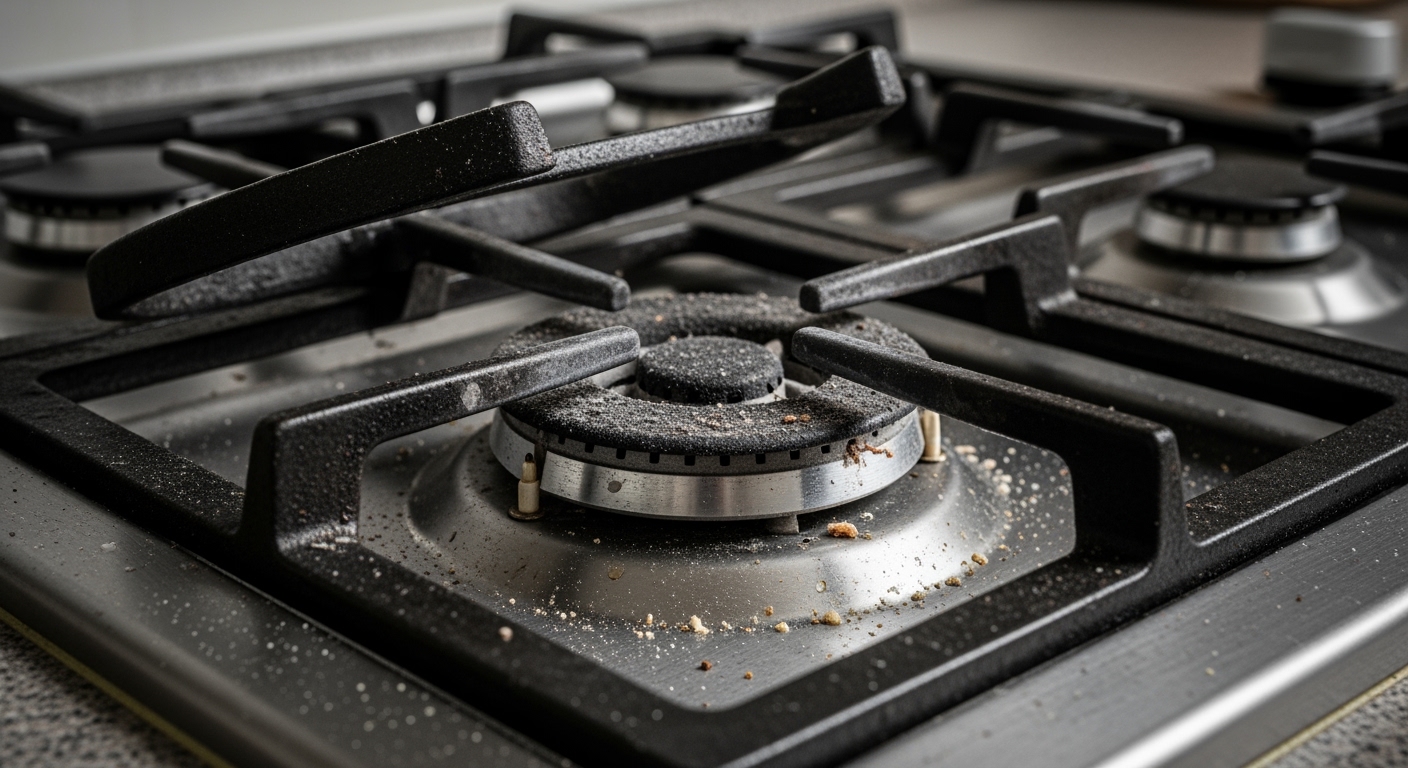
Spring cleaning has a way of exposing things you did not plan to deal with. You pull the range away from the wall to mop up a year’s worth of crumbs, and suddenly the kitchen smells like rotten eggs. Or you scrub the burner caps, put everything back together, turn a knob, and get clicking, a lazy flame, and a faint gas odor that definitely was not there before.
That is the moment to stop treating it like a cleaning project.
A gas range is useful, familiar, and easy to take for granted. It is also one of the few appliances in your home that combines fuel, heat, ignition, and indoor air in one place. Most days, that is fine. When something is off, though, the change can be small at first: a burner that lights slowly, a smell that lingers, an oven that takes forever to preheat. People ignore those signs all the time because the appliance still sort of works. I get it. Half-broken appliances are weirdly easy to live with until they become impossible to ignore.
This article walks through what a gas smell actually means, why spring cleaning often uncovers range problems, what you can safely check yourself, and when it is time to stop troubleshooting and call certified technicians.
A lot of range issues show up during deep cleaning because that is when the appliance gets disturbed.
For months, your stove or range may sit in the same position, with the same grime buildup, the same slightly loose connection, and the same burner cap that is almost aligned but not quite. Then spring comes around. You scrub harder, remove parts, pull the range forward, maybe clean behind it for the first time in ages, and suddenly a hidden problem gets a chance to announce itself.
A few common spring-cleaning triggers:
Burner caps get put back slightly crooked.
Food debris gets loosened and drops into burner openings.
Cleaning solution seeps into igniters or gas ports.
The flexible gas connector gets bumped when the range is moved.
Grease buildup that was interfering with ignition gets redistributed instead of removed.
Vent openings get blocked by foil, liners, or misplaced parts during reassembly.
None of this means you did something reckless. It usually means the appliance already had a weakness, and cleaning exposed it.
Natural gas and propane are treated with odorants so people can detect a leak. That sulfur or rotten-egg smell is not supposed to be subtle background kitchen scenery. If you smell it clearly, pay attention.
That said, context matters.
A brief whiff right as a burner ignites can happen. Gas is released, the igniter sparks, the flame catches, and the odor disappears almost immediately. That is different from a smell that lingers for several seconds, returns repeatedly, or hangs around when the appliance is off.
Here is the simple version:
A very brief odor during ignition that disappears right away
A smell traced to old food, a drain, or trash, not the range
A temporary burnt odor after cleaning residue heats up for the first time
Gas smell when all burners are off
Gas smell that stays in the room
Gas smell paired with clicking but no ignition
A burner that lights with a “whoosh” or small pop
Gas odor from the oven cavity during preheat
A hissing sound near the appliance or shutoff valve
People sometimes second-guess themselves because kitchens have plenty of bad smells. Burnt grease, sour spills, old onions in the trash, something dying behind the refrigerator. But gas has a distinct sharpness. If you are wondering whether it might be gas, do not dismiss the possibility because the smell is “probably just the kitchen.”
A gas range can develop several faults, and some are easier to spot than others.
This is one of the most common problems after cleaning. Burner caps and heads need to sit exactly where the manufacturer designed them to sit. If one is off by even a little, the gas flow and ignition pattern can change. You may get uneven flames, delayed ignition, clicking, or a smell of unburned gas.
I have seen people clean a cooktop beautifully and then accidentally create a problem just by placing the parts back in the wrong position. It feels unfair, but it happens.
Grease, boiled-over sauces, and crumbs can block the tiny openings where gas exits. When that happens, the flame may turn uneven, weak, or yellow instead of steady blue. Gas may not burn completely. That can leave soot on cookware and make the burner harder to light.
Never widen those ports with a drill bit or anything aggressive. A gentle cleaning method matters here.
If the igniter takes too long to light the gas, you can get delayed ignition. That is when gas builds up for a moment before catching. The result is often a stronger smell and sometimes a small flare or puff sound. On oven burners, a weak igniter is a classic cause of long preheat times and intermittent gas odor.
When a range is moved, the flexible gas connector can be strained. Older connectors may already be worn, kinked, or corroded. If a fitting loosens or a line is damaged, that is not a cleaning nuisance. That is a leak risk.
A burner knob that does not seat properly, an internal valve problem, or a control issue can allow gas flow when it should not. These faults are repair issues, not cleaning issues.
There is a big difference between “this needs repair soon” and “leave the house now.”
Leave the home and call your gas utility or emergency services from outside if you notice any of the following:
A strong gas odor that does not go away
Gas smell when the appliance is off
A hissing sound near the range, connector, or wall shutoff
A burner releasing gas but not lighting
Physical symptoms like dizziness, nausea, headache, or trouble breathing
A carbon monoxide alarm sounding
Visible damage to the gas line or connector
Do not stop to finish cleaning. Do not test switches. Do not turn lights on or off. Do not use your phone while standing in the kitchen. Leave first.
If you know how to shut off the gas safely and can do it without delaying your exit, that can help. But if the odor is strong, the priority is to get everyone out and make the call from outside.
This is one of those situations where typing “Gas Stove Repair Near me” too early can actually distract you. Safety first, appointment second.
Most routine cleaning is safe if you go slowly and reassemble everything correctly.
Turn the range off and let it cool completely. If the manufacturer instructions allow it, disconnect power before cleaning the igniters and control area. Even on a gas range, many parts still use electricity for spark ignition, lights, or control boards.
Take off grates, burner caps, and removable burner heads if your model allows it. Keep parts grouped by burner if they are not identical. Taking a quick photo before disassembly is smarter than trusting memory. I say that as someone who has absolutely trusted memory and regretted it.
Warm water, dish soap, and a non-abrasive brush handle most grime. A mild degreaser can help with heavy buildup. Avoid flooding the cooktop with liquid. Spraying cleaner directly into gas openings or igniter areas is a bad idea.
Also, do not mix cleaning chemicals. Bleach and ammonia are an especially awful combination.
If the burner ports have buildup, use a soft brush, wooden toothpick, or manufacturer-approved tool. Be gentle. The goal is to remove debris, not reshape the burner.
Moisture in the wrong place can interfere with ignition. Let parts dry completely before reassembly.
This matters more than people think. Burner caps must sit flat. Burner heads must lock into place correctly. Grates should not rock or tilt. If one burner looks different from the others after reassembly, stop and fix it before testing.
After cleaning, turn on one burner and watch the flame. A healthy gas flame is usually blue and steady. If you get repeated clicking, uneven flame, yellow tips, or a gas smell that lingers, turn it off and stop there.
Cleaning helps with dirt. It does not fix worn igniters, cracked valves, failing controls, or gas leaks.
Call for range repair, stove repair, cooktop repair, or oven repair if you notice any of these:
Repeated clicking after the burner lights
Burners that ignite slowly or inconsistently
Flame that is mostly yellow, orange, or unusually large
Soot on pans or around the burner area
Oven that smells like gas during preheat
Oven that takes much longer than usual to heat
Burner knobs that feel loose or fail to control flame properly
Any gas smell when the appliance is off
Damage, corrosion, or kinks on the gas connector
For gas-related issues, certified technicians are the right call. This is not the place for guesswork or trial-and-error parts swapping. If the problem feels urgent but not emergency-level, many homeowners look for same day service or Same Day Appliance Repair. That makes sense when the appliance is central to daily cooking, but only after the immediate safety question is settled.
This part gets muddled a lot.
Natural gas itself has an added odor so you can detect a leak. Carbon monoxide does not have a smell. You cannot sniff it out. It is produced by incomplete combustion, which can happen when a gas appliance is not burning properly.
So while a gas smell does not automatically mean carbon monoxide is present, a poorly functioning range or oven can contribute to combustion problems. That is one reason yellow flames, soot, and sluggish ignition matter. They are not just annoying. They may point to a burner that is not operating the way it should.
Every home with fuel-burning appliances should have working carbon monoxide alarms. That includes homes with gas stoves, gas dryers, furnaces, or water heaters.
Once you are already in maintenance mode, it makes sense to give the rest of the house a quick look. This is where small problems often show up before they turn expensive.
Dryers deserve more attention than they usually get. Lint buildup, crushed vent hoses, and weak airflow create a fire risk and make drying times longer. If a gas dryer smells odd or overheats, that is not a wait-and-see issue. People often search for Dryer Repair near me when the machine starts taking two cycles to finish a load, but the vent may be the real culprit.
Washers have their own spring surprises: cracked hoses, mildew around the door gasket, and slow drainage. If you have a stacked laundry unit, Stackable Washer dryer repair can be a little more involved simply because access is tighter. The same goes for general washer repair or Washing machine Repair. A tiny leak today becomes floor damage later.
Refrigerators and freezers also deserve a check. Dirty condenser coils make the unit run hotter and longer. Worn door seals waste energy. Ice maker lines can leak quietly for weeks. Fridge Repair, refrigerator repair, freezer repair, and ice maker repair calls often start with “I was cleaning behind it and noticed...”
Even electric models are worth checking. Electric Stove Repair is a different category than gas, but loose elements, damaged wiring, and scorched receptacles are still safety problems.
If you live in Maple Ridge and Surrounding Areas, spring is a good time to do a simple whole-home appliance walk-through. You do not need to become a repair expert. You just need to notice changes early.
When the problem is not an emergency, a few notes can make appliance repair faster and more accurate.
Write down:
Which burner or function is affected
Whether the smell happens during ignition, during use, or while off
Whether the issue started after cleaning or moving the appliance
Flame color and behavior
Any sounds, like clicking or whooshing
The model number, if easy to access
This helps whether you are searching Appliance Repair Near me, Stove Repair Near me, Oven Repair Near me, or Cooktop Repair Near me. The better the description, the easier it is for the technician to bring the likely parts and diagnose the issue quickly.
If a gas range smells wrong, acts wrong, or lights wrong after cleaning, stop treating it like a housekeeping problem.
A little maintenance goes a long way. Clean carefully. Reassemble carefully. Pay attention to changes. But once gas odor, delayed ignition, or line issues enter the picture, the job changes. At that point, you are no longer doing spring cleaning. You are dealing with a safety issue.
And honestly, that is good to know early. It is much easier to handle a repair than to explain why everyone ignored the smell for a week.

Master Appliance Service offers certified appliance repair solutions in Maple Ridge and surrounding cities with licensed technicians delivering prompt, reliable service. Enjoy transparent pricing, secure payments, and a 3-month warranty on parts and labor. Trust us for dependable and convenient home appliance repairs.
